
The Full Comparison
| Parameter | HVLS Fan | Conventional Ceiling / Wall Fan |
|---|---|---|
| Diameter | 12 – 24 ft (3.6 – 7.3 m) | 3 – 5 ft (0.9 – 1.5 m) |
| Operating Principle | High volume, low speed — 0 to 70 rpm | Low volume, high speed — 300 to 900 rpm |
| Area Coverage (per fan) | up to 20,000 sq.ft. | roughly 150 sq.ft. |
| Fans For 15,000 sq.ft. | 1 fan | approx. 100 fans |
| Power Consumption | approx. 0.1 W per sq.ft. | approx. 2.5 W per sq.ft. |
| Air Quality & Feel | Gentle, uniform air movement; dust and lint stay settled | Directional high-velocity draught; lifts dust and lint |
| Destratification | Yes — mixes the full floor-to-roof volume | No — operates only in a narrow band |
| Winter Use | Yes — reverse rotation brings warm ceiling air down | No practical winter benefit |
| Noise | 40 – 65 dB depending on drive type | Cumulative noise from many units |
| Maintenance Points | 1 fan per zone | Dozens of motors, cables and switches per zone |
| Capital Cost | Higher per unit | Lower per unit |
| Operating Cost | Substantially lower for equivalent coverage | High — every unit runs continuously |
| Floor Space | None — ceiling mounted | Pedestal units occupy floor and obstruct movement |
Figures are typical planning values for an industrial building. Actual numbers depend on roof height, floor plate shape and what is being replaced.
One Fan Against One Hundred
For a 15,000 sq.ft. floor, this is what each option looks like installed.
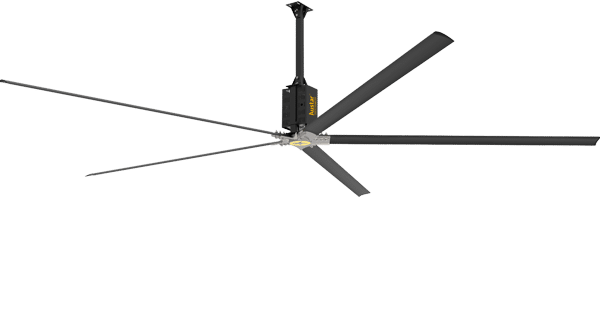
HVLS Fan
A single 24 ft AS245 covering the full floor plate. One motor, one drive, one maintenance point, one cable run.
- Power
- ~0.1 W/ft²
- Maintenance Points
- 1
Conventional Fans
Roughly a hundred ceiling or wall mounted units to cover the same area — and most of the floor still sits between them.
- Power
- ~2.5 W/ft²
- Maintenance Points
- 100
HVLS vs HVAC
The honest answer is that these are not always alternatives. In a tall industrial shed, HVLS replaces HVAC outright. In an air conditioned building, it makes the HVAC work less hard — and that is usually the bigger saving.
| Parameter | HVLS Fan | HVAC System |
|---|---|---|
| Capital Cost | Low — fan, structure and panel | High — plant, ducting, insulation |
| Operating Cost | Very low | High — chiller load dominates |
| Response Time | Effective within a minute | Needs pre-conditioning |
| Suits Tall Sheds | Yes — performance improves with height | Poorly — volume works against it |
| Air Temperature Drop | No — perceived drop only | Yes — actual cooling |
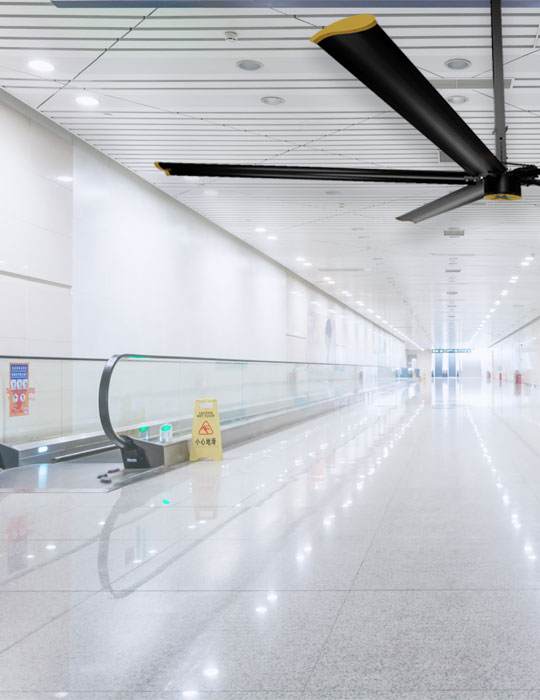
| Used Together | Yes — common in airports and large halls; destratification allows a higher HVAC set point for the same comfort | |
Work out the number for your own facility.
The ROI calculator takes your shed area, roof height, working hours and electricity tariff and returns the monthly and annual saving against your existing arrangement.