
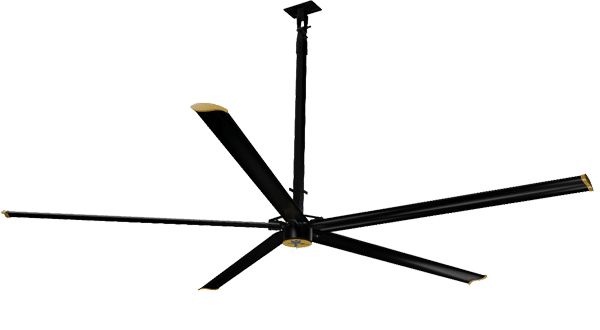
Gearless
Gearless 12 Feet HVLS Fan
- Diameter
- 12 ft
- Air Delivery
- 180,000 CFM
- Coverage
- up to 6,500 sq.ft.
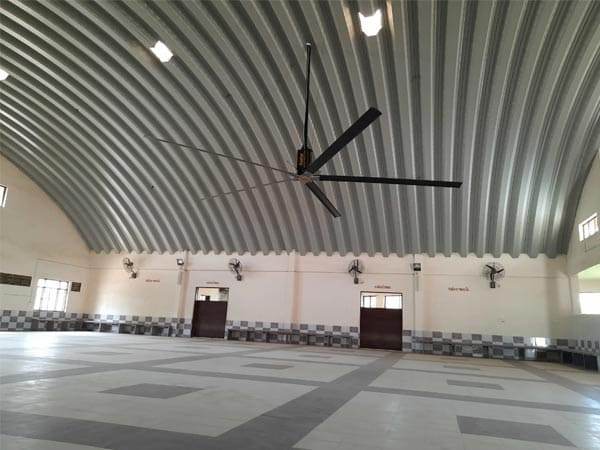
A banquet hall is empty and cool at 6 pm and packed and hot by 9 pm. Guest load, kitchen heat and lighting all arrive at once, and full HVAC for a space used a few evenings a week is hard to justify. Conventional fans are loud enough to interfere with conversation and speeches, and pedestal fans have no place in a decorated hall.
Gearless HVLS fans run below 40 dB — quiet enough that a guest at a table under one will not notice the fan is there, only that the air is moving. A single large fan covers the seating area with even, gentle airflow, giving the 4 – 5 degree perceived drop that matters most when the hall fills up. The glossy black finish reads as a design element rather than equipment, and custom colours are available, and in semi-open venues the fans keep insects moving away from the dining area.
Typical selections for this facility type. Final size and quantity come out of the feasibility study once we have your roof height and layout.
Gearless
Gearless
Gearless
The gearless range runs below 40 dB, which is quieter than normal conversation. Guests will feel the air movement without hearing the fan.
Yes. Matt Black, Silver, Pure White, Off White or Red on the geared range; Matt Black, Silver, Pure White or Dark Gray on the gearless range. Any RAL number can be ordered.
A 16 ft or 20 ft gearless fan covers a substantial seating area. For long rectangular halls two smaller fans usually give better coverage than one large one — the feasibility study works out which.
Yes, and it is one of the most common installations. Air movement also helps keep insects away from the dining area.
Industry is pre-selected. Add your dimensions and we come back with a fan size, a quantity and a layout drawing.
Send us the basics and our team will respond within one working day.
Give us your shed bay by bay and we come back with a fan size, a quantity and a layout drawing — no charge, no obligation.
Measure each bay on its own — length, width, and roof height from the floor to the underside of the truss. Then take two or three photos looking straight up at the roof, so we can read the roof type and the hanging arrangement.