Made in Ahmedabad INDIA · Exporting worldwide
The Challenge

What Goes Wrong Without It

Textile floors run hot. Machines throw off heat continuously, humidity is often held deliberately high for yarn behaviour, and stitching floors pack a large number of operators into a fixed layout. Pedestal fans at each table lift lint and loose thread into the air and take up floor space, while the operators furthest from a fan work in still air. Productivity drops through the afternoon and quality follows it.

The Austar Solution

How HVLS Fixes It

Ceiling mounted HVLS fans deliver uniform, low-velocity air across the whole floor, so every operator position is treated the same. Because the air moves slowly over a wide area rather than fast over a narrow one, lint stays down instead of being whipped into circulation. The wind chill effect gives the perceived 4 – 5 degree drop that keeps operators comfortable through a full 10 – 12 hour exposure, and floor space that was occupied by pedestal fans goes back to production.

Recommended Models

What We Usually Specify Here

Typical selections for this facility type. Final size and quantity come out of the feasibility study once we have your roof height and layout.

At Site

Installation Considerations

  • Layout is planned around the machine grid so blades clear overhead service lines and lighting.
  • In sheds with north-light or saw-tooth roofs, hanging structure is fixed to the truss bottom chord.
  • Mounting height of 18 – 25 ft suits most weaving and stitching floors.
  • In humid processing areas the control panel is mounted away from steam and wash-down zones.
  • Where humidification plant is running, fan speed is set so the humidity profile is not disturbed.
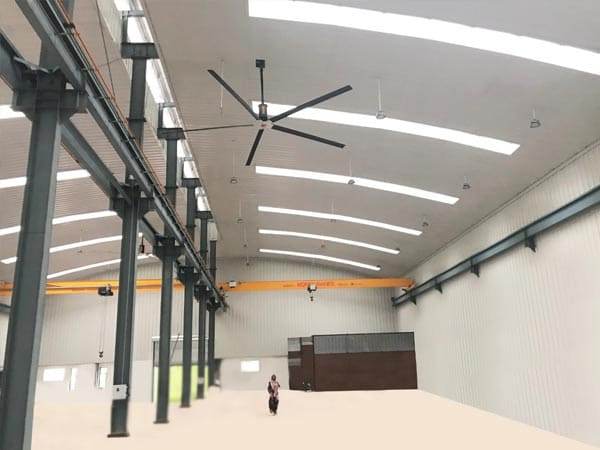
Textile & Garment Units installation
Project Reference

Installed In The Field

See The Full Installation Gallery
Questions

Asked By Textile & Garment Units

No — that is the difference between high-volume low-speed and conventional high-speed fans. Air velocity at floor level is gentle, so lint settles rather than circulating. Most units report cleaner floors after switching from pedestal fans.

They generally help by distributing the conditioned air evenly instead of leaving pockets. Speed is set at commissioning so the humidity profile stays where your process needs it.

Yes. Reverse rotation at low speed pulls the warm ceiling layer down to floor level without a draught, which is genuinely useful in northern units.

Every pedestal fan removed frees roughly 4 sq.ft. of floor plus its cable run. On a large stitching floor this adds up to several machine positions.

All Frequently Asked Questions
Free Of Charge

Feasibility Study For Your Textile & Garment Units

Industry is pre-selected. Add your dimensions and we come back with a fan size, a quantity and a layout drawing.

Two or three photos looking up at the roof, plus a layout drawing if you have one. This is how we read the roof type and the hanging arrangement.

Free of charge, no obligation. We reply within one working day.