
How Does an HVLS Fan Work?
An HVLS fan pushes a broad column of air down from the ceiling. When that column reaches the floor it does not stop — it migrates outward across the slab in every direction, travelling a long way because the air is moving slowly and losing very little energy to turbulence. At the walls it turns and rises, and the fan draws it back in at the top. The whole building becomes one slow circulation loop.
Two things happen as a result. The first is destratification. Hot air rises and collects under the roof, so an industrial building typically has a temperature gradient of eight to twelve degrees between floor and ceiling. The fan pulls that layer back down and mixes it through the full volume, and the building equalises. This is why an HVLS fan is useful in winter as well as summer — run in reverse at low speed, it brings warm ceiling air down to floor level without creating a draught.
The second is the evaporative cooling effect, usually called wind chill. Moving air across skin accelerates evaporation, and the perceived temperature drops by four to five degrees even though the air temperature has not changed at all. For a person working an eight or twelve hour shift, that is the difference between manageable and exhausting.
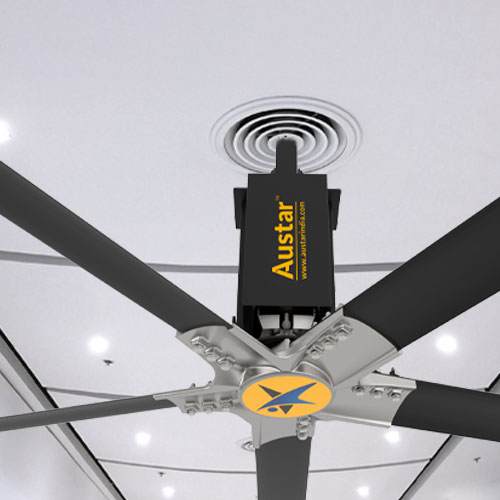
Where They Fit
- Uniform air distribution across the whole floor rather than under each fan
- Comfortable through a 10 – 12 hour exposure, not just in short bursts
- Effective in both summer and winter, using forward and reverse rotation
- Works alongside HVAC in conditioned buildings, allowing a higher set point
Key Components
Gear Motor
Nord / SEW German make, IE2, IE3 on special request
Blade Mounting Hub
Single piece die cast aluminium, radiography tested
Blades
Aluminium 6063 T6, broadest section in market, two ribs
Drive
Danfoss VFD on the geared range, Delta on the gearless range
Control
Keypad for start/stop, reverse/forward, speed; plug-and-play cabling
Hanging Structure
IS 2062 M.S. tested material, certified welders, SS wire rope restraint
What You Actually Get
Increased worker and livestock productivity
Heat fatigue is measurable. On a factory floor it shows up as declining output through the afternoon and rising defect rates towards the end of a shift. In a dairy shed it shows up as reduced feed intake, lower milk yield and poorer conception rates. Uniform air movement across the whole floor addresses the cause rather than treating the operators nearest a fan.
Cost saving and return on investment
A conventional arrangement covering a large floor runs at roughly 2.5 W per sq.ft.; an HVLS arrangement covering the same floor runs at roughly 0.1 W per sq.ft. Where HVAC is present, the larger saving is usually on the chiller — destratification lets you raise the set point by a couple of degrees for the same perceived comfort. For most industrial facilities running two shifts, payback falls within the first two years.
Noiseless operation
Geared models run at 60 – 65 dB, well below the machinery noise floor of an industrial building. The gearless direct drive range runs below 40 dB — quieter than normal conversation, which is what makes it specifiable for airport concourses, prayer halls, banquet spaces and libraries.
HVLS Adoption In India
Indian industrial and commercial buildings historically solved the heat problem two ways: full HVAC where the budget allowed, and a wall of mounted air circulators where it did not. Both had structural problems. HVAC in a tall, leaky industrial shed is expensive to install and punishing to run. Wall mounted circulators are cheap to buy but cover very little, run continuously, and leave most of the floor untouched.
HVLS fans changed the calculation because they scale with building volume rather than against it. The taller the building, the better an HVLS fan performs — which is the exact opposite of every conventional option. Over the last decade they have displaced HVAC dependency in warehouses and manufacturing, replaced circulator banks almost entirely in workshops, and moved into air conditioned buildings as a way of making the existing HVAC work less hard.
Size Selection Guide
| Diameter | Air Delivery | Indicative Coverage | Typical Use |
|---|---|---|---|
| 12 ft | 135,000 CFM | up to 6,500 sq.ft. | Service stations, small workshops, showrooms |
| 16 ft | 185,000 CFM | up to 10,000 sq.ft. | Mid-size workshops, packing halls, stitching floors |
| 18 ft | 200,000 CFM | up to 13,000 sq.ft. | Large bays, textile processing, moulding halls |
| 20 ft | 350,000 CFM | up to 16,000 sq.ft. | Warehouses, logistics halls, assembly lines |
| 24 ft | 390,000 CFM | up to 20,000 sq.ft. | Distribution centres, terminals, convention halls |
Coverage scales with mounting height The same fan covers a much smaller circle at 18 ft than at 35 ft, because the air column needs vertical distance to spread before it reaches the floor. Never size from floor area alone.
Common Questions
An HVLS (High Volume Low Speed) fan is a mechanical fan greater than 7 feet (2.1 m) in diameter that moves a large volume of air at low rotational speed. It works on the opposite principle to a conventional fan, which moves a small volume of air at high speed.
Diameter and speed. A conventional fan covers a few square metres directly beneath it; an HVLS fan of 24 ft covers up to 20,000 sq.ft. because slow-moving air travels much further before it dissipates. One HVLS fan replaces roughly 100 conventional fans over a 15,000 sq.ft. floor.
Hot air rises and collects under the roof, leaving a temperature gradient of eight to twelve degrees between floor and ceiling. An HVLS fan pushes that layer back down and mixes it through the full volume, so the building equalises. This is what makes the fan useful in winter as well as summer.
They do not cool the air. They produce a wind chill effect that makes the space feel 4 to 5 degrees cooler at working level, and destratification evens out the floor-to-roof gradient. For most industrial spaces that is what comfort actually depends on.