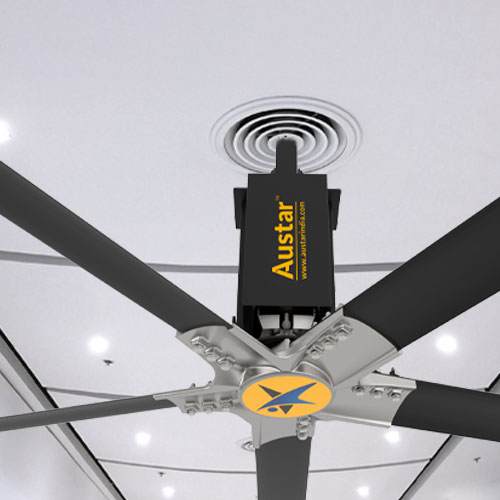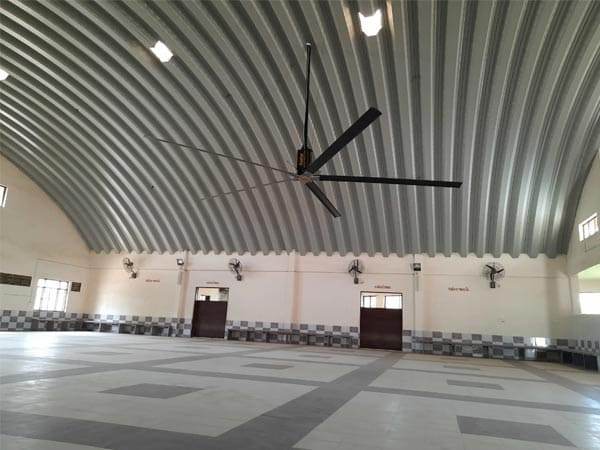
The comparison in watts per square foot
A conventional fan arrangement covering a large industrial floor works out at roughly 2.5 W per sq.ft. of covered area. An HVLS arrangement covering the same floor works out at roughly 0.1 W per sq.ft. That is the number behind the claim that one HVLS fan does the work of a hundred conventional fans over 15,000 sq.ft.
Why the difference is so large
A conventional fan moves a small volume of air fast, and that air loses its energy to turbulence within a few metres. To cover a large floor you need many of them, each drawing power continuously and each cooling only the operator directly in front of it. An HVLS fan moves an enormous volume slowly, and slow-moving air travels much further before dissipating. The physics rewards diameter, not speed.
What it looks like on the bill
Run the numbers for your own facility rather than taking a generic figure. The ROI calculator on this site takes shed area, roof height, working hours, working days and your electricity tariff and returns the monthly and annual saving alongside the payback period. For most industrial facilities running two shifts, payback falls within the first two years.
The savings that do not appear on the fan bill
Where HVAC is present, the larger saving is often on the chiller rather than the fans. Destratification lets you raise the set point by a couple of degrees for the same perceived comfort, and chiller load responds directly to set point. In air conditioned terminals and large halls this is usually the dominant number.